

First Read Chapter 1 (pt 1)
IN SPRING OF 1996, AFRICAN AMERICAN NOBEL PRIZE IN LITERATURE LAUREATE TONI MORRISON delivered the 25th Jefferson Lecture in the Humanities. It is known as the U.S Government’s highest honor of intellectual and creative accomplishments, she was the second Black woman to receive it after Gwendolyn Brooks who spoke two years early.
Morrison walked up cemented stairs towards the John F. Kennedy Center for the Performing Arts in Washington D.C. to unleash her vision of our crisis of meaning in the modern world.
Titling her lecture “The Future of Time” she stood behind a podium to proclaim that any imagination of the far future has been a desperate exercise as she put it ‘to alter the present as past’ and that it gave no credence to the creative powers we hold as a human species to transform and evolve ourselves, she claimed this inclination towards the past locks us to a staring contest. She asserted that our tendency to view the past through the lens of technology’s future confines us to a disturbing context that is now deeply embedded in the very fabric of our perception, preventing us from comprehending the past, foreseeing the future, or actively inhabiting it.
Morrison said in the West we look to the past as if it’s a slow moving progress bar, living inside a ‘cult of progress’ I am calling this. A singular modality that we humans exist at the forefront of better things to come. This brings only the horrors of our history to remain, in an effort to bypass them, it offers nothing for the future of humanity she says, we are stuck in a loop, it locks us to a frame of mind and our thinking is seemingly bounded perpetually to a single tune, to the ways it must evolve and what once was, not the future, we can never truly see the future in the west, but an endless aiming, we are imprisoned toward a “time without a future”.
Pointing to the prefixes of different eras: post-modern, post-structuralist, post-cold war that have been heavily used in our western culture signifies the ever so presence of our re-imagining the future of our present as past.
‘Post-World War II’ beyond the bombs we dropped over Hiroshima and Nagasaki, exploding and disintegrating over 200,000 Japanese men, women, children, families, all but to halt a great evil, the axis of evil from advancing, threatening the progress we had made.
‘Post-Colonial’ beyond the African slaves who were forcibly transported in chains, subjected to torture and body mutilations across the Caribbean, the Americas, and the United States while laboring on plantations that underpinned a historical slave-based economy. Pointing to the enduring repercussions of imperialism in Africa and various other regions around the world that persists today.
Toni Morrison highlights a profound insight: when we explore the Western past with the assumption of a shared linear societal progression of industrialization, we frequently perceive non-Western groups, such as African indigenous groups, as trailing behind and categorize them as ‘uncivilized.’ And even worst we see the horrors our ancestors have committed, the blood dripping in their hands and ours supposedly, having cleaner hands because the fabric of our modern society have us to believe through time, we should have evolved and progressed, through time it should and must get better years after years, through time we should all be more well adjusted and maybe perhaps, generations after us will absolutely be better in the changes that would and should be achieved in our lifetimes that we also might never ever see.
Contrary to Francis Fukayama’s viewpoint, the author of The End of History and the Last Man, Morrison would argue that the global expansion of liberal democracy and free markets doesn’t mark the end of history, she would say it’s a profound lack of imagination, a blatant symptom of living in a time without a future. A failure to recognize our shortcomings.
Fukayama argued that the global proliferation of liberal democracy and free markets signaled the culmination of history, denoting the end of ideological evolution and heralding an era of modernity, characterized by increased peace and prosperity. While certain elements of Fukayama’s argument may hold merit, one must consider the perspective of those who participated in the 17th century inspired Salon Discussion I hosted in D.C. back in 2019. Over Fifty attendees, myself included, unequivocally shared a profound crisis of meaning and loneliness perturbed us emotionally, psychologically, cognitively, and socially. This seemed to be marked by a lack of social connection and an increased need for a meaningful community that wasn’t readily accessible. In light of this, can we genuinely argue that we’ve achieved the ultimate structure to living as humans in this new age of modernity while a prodigious societal crisis brews inside of us?
Morrison really challenges Fukayama’s notion and says an erasure starts to occur somewhere unseen deep inside of our imagination, it’s because of that she wasn’t interested in this ‘signs of progress’ as she framed it in her lecture, a post marker of our western societies always seeking to reimagine the future of our present as past.
One of the key problems Morrison highlighted in her lecture taking a pose to drink a small bottle of water, she says that our inability to imagine a thriving deep future for ourselves stems from this “Secularization of Culture” where she juxtaposes this erasing force in the name of a progressive future, the west has washed away and then painted over the complex colors of what makes us human in the process which I believe to be the very same elements that Nietzsche saw was disappearing in Greek Society as they embraced socratic rationalism.
How ‘the modern human’ has been created from the notions of western values forces an intellectual and ethical superiority and linearity that displaces within all of us all those previous things that once casted us as deeply spiritual, creative, social and unexplainable magical beings in this universe. Losing these has come, she believes, to be the grand challenge of our times and as we will see later in this chapter creates a major contribution to our meaning crisis. I do want to emphasize that as societies undergo this increased process of secularization through modernity, it’s fueling the increasing disappearance of numerous religious rituals and the sense of community they bring and meaningful spaces. Many studies have shown us results in a descent into greater isolation. This phenomenon effectively triggers the crisis, especially considering the more significant role religion once played in our lives in earlier societies as Nietzsche, Putnam and Durkheim showed us.
In the 21st century we are living in a time where the afterlife is seen to be an absurd medical impossibility. Within intellectual and literate discourse, the idea of an ‘indestructible soul’ is not only hard to accept but is also growing increasingly incomprehensible. Where deeply held religious belief has now become synonymous with ignorance. Where this suspicion of eternal life, to the absence of resurrection and reincarnation that once casted humanity “to all times to come,” this seemingly Morrison says all of this condemns us to a biological space of a very single life, a human being now bound to death in a void filled mind constraining our ability to create meaning even more. We thus as humans for the first time in our history are a decomposing thing waiting to be buried in an ocean of nihilism, our brains lobotomized away from the very magic of our universe disconnected from our past, disconnected from our future, most importantly disconnected from each other because this overarching meaning that once connected has been fragmented by modernity.
Morrison says this future in the west now becomes a very discoverable physical space since we are no longer thrusted to all times and increasingly disconnected from each other, it is then to this outer space we seek, towards the stars in the sky.
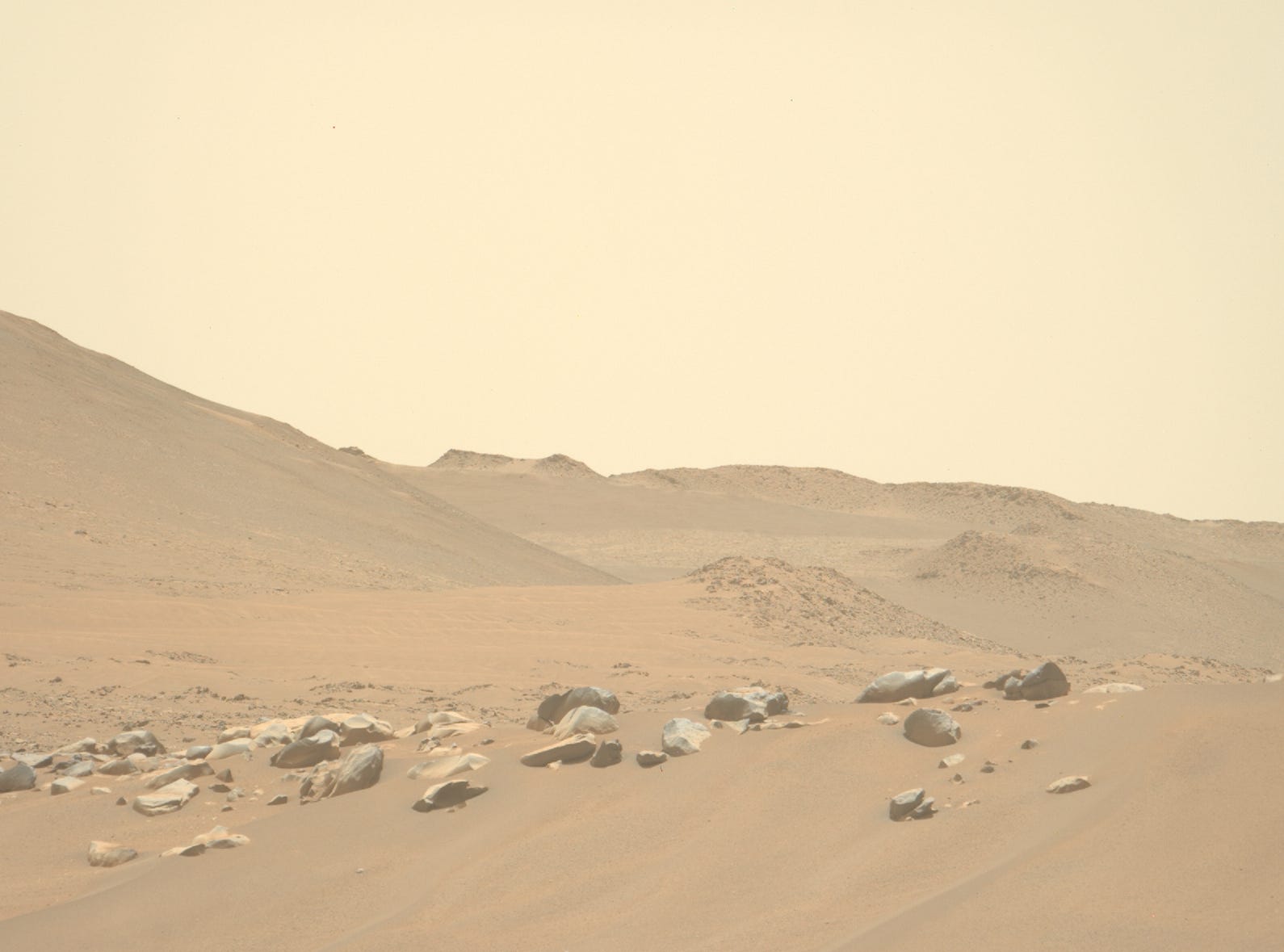
Figure 4.2: NASA’s Mars Perseverance rover acquired this image using its Left Mastcam-Z Camera
In this age dominated by Elon Musk’s SpaceX and the mesmerizing Mars Exploration Rover’s missions, such as the remarkable landing of Perseverance in 2021 as seen in Figure 4.2, I and all of us, we are deeply enthralled by the vivid images and discovery of expansive distant new horizons, red mountains, and Martian sands captured for the very first time in human history during its exploration of the Jerezo crater on Mars, allowing us to peer into the mysteries of the Martian Red Planet like never before. Morrison points us to see this is in fact a future towards the discovery of more past time. The discovery of billions of years gone by since the start of our universe, as claimed by our Western sciences.
Toni Morrison really has laid for us an incredible vision. Our progress towards an increasingly modern society doesn’t lead to the outcome that we desire.
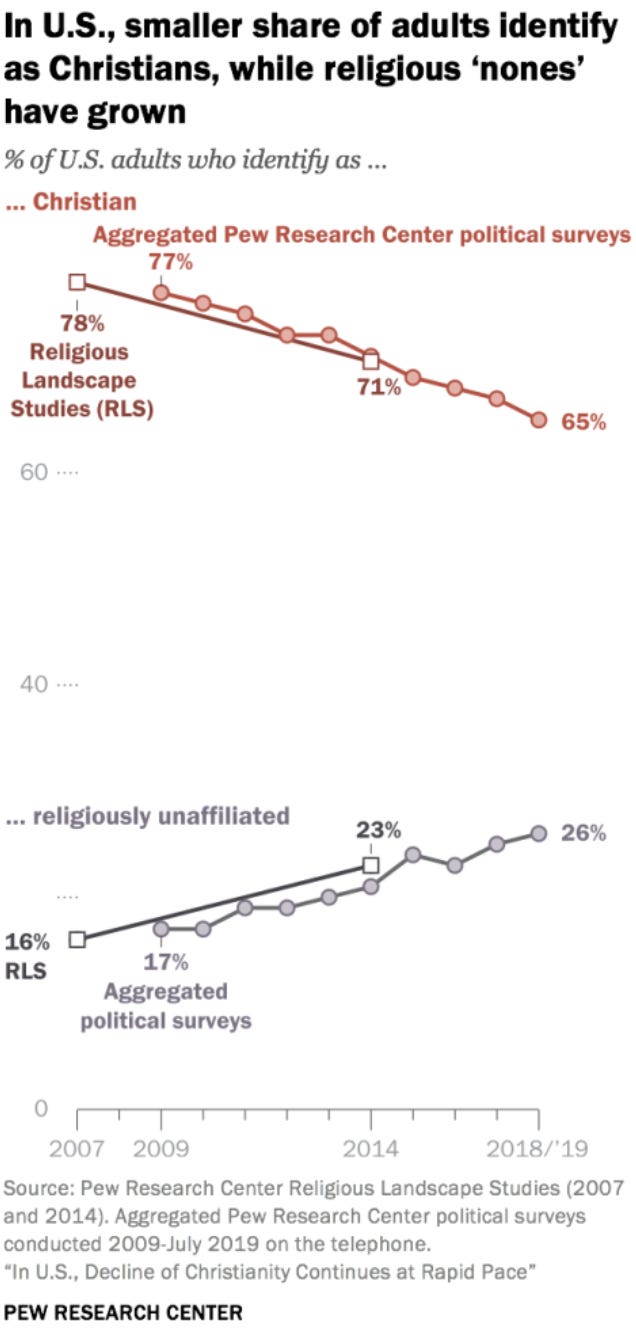
Figure 4.3: Smaller share of adults identify as Christians.
If you look at Figure 4.3 you will see that more and more U.S adults identify as religious nones. This percentage has been growing since 2017, while the numbers of U.S adults that identify as Christians has dramatically decreased. Even more so, religious preference, involvement, and affiliation among U.S. adults have waned, especially since the 1970s which was demonstrated by Robert Putnam earlier this chapter. By 2020, just 47% of Americans claimed membership in a church, synagogue, or mosque, dropping from 70% in 1999, marking the first sub-50% figure in the survey’s history. It’s essential to distinguish between religious institutions where communities of people practice their faith together, engaging in collective actions, and the concept of faith itself, which involves believing in something or someone even in the absence of concrete proof.
However, as the proportion of religiously unaffiliated individuals (often referred to as “nones”) continues to grow in our modern communities and with the increasing influence of technology in our lives, so too places the coffin on the nail on all spaces where people have access to gather in person on a regular basis to talk, to share, and find new meaning and connections between each other.
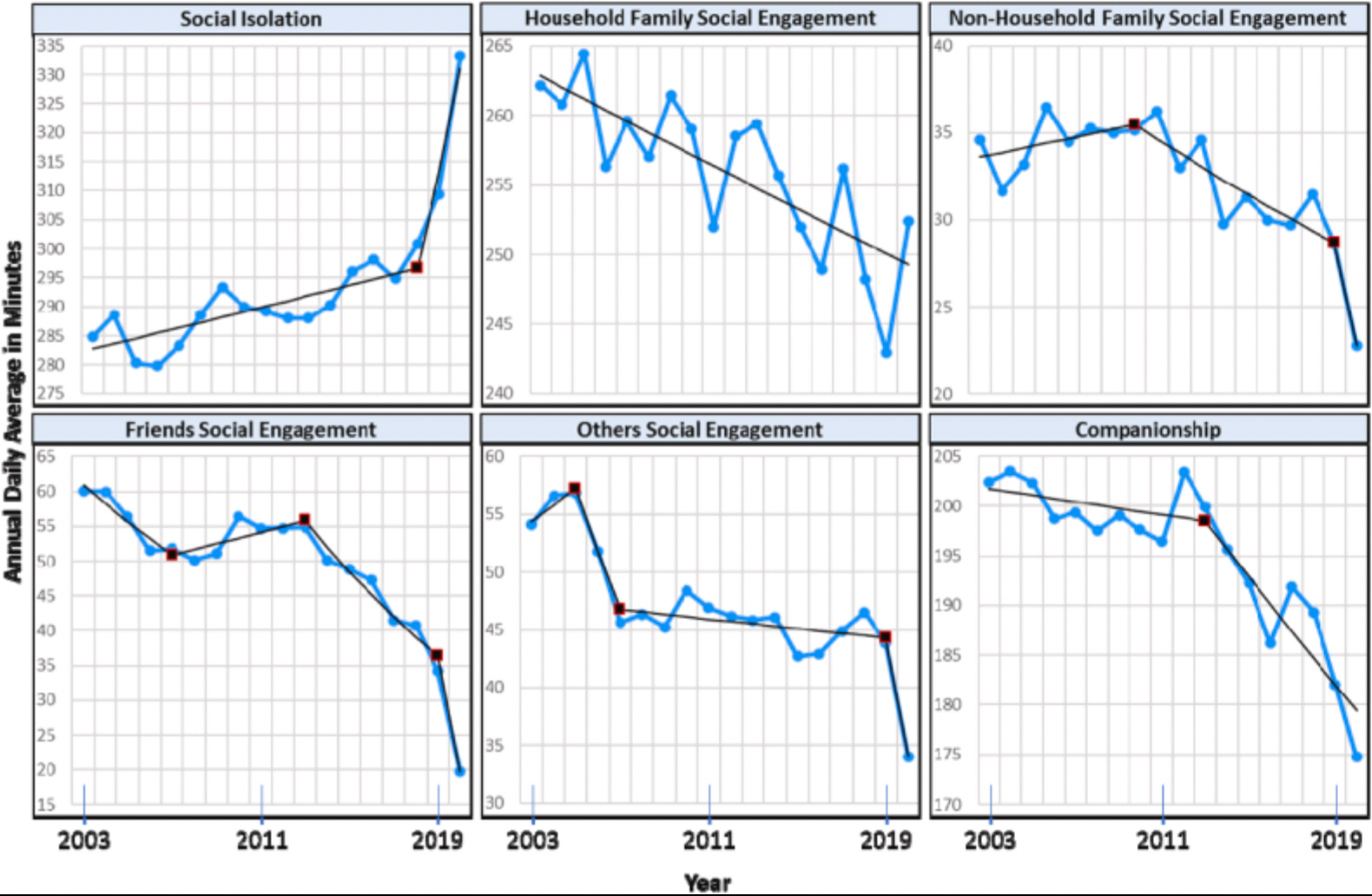
Figure 4.4: Annual daily average minutes, 2003–2020, shown in blue trend lines, with significant slope changes marked by black lines and red-bordered squares.
If you look at Figure 4.4, it reveals insights from the 2003-2020 American Time Use Survey, showing a national increase in social isolation, and a startling decrease in social engagement with family, friends, and ‘others,’ as well as a diminishing sense of companionship in shared leisure and recreational activities. This suggests that opportunities and spaces for building and maintaining social bonds have drastically dwindled over the last decade. The 17th century French style Salon discussions I hosted in Washington, D.C., was a meaningful space that I am now realizing is becoming increasingly rare in the west. Emmanuel’s words from that afternoon in Sierra Leone continue to echo in my mind, highlighting the pivotal role that community played in enabling his people to persevere through the most difficult times. We in the west are losing that community at a fast rate.
IF NOBEL LAUREATE MORRISON, ALONG WITH DURKHEIM, HUSSERL, AND NIETZSCHE, who are recognized as the founders of major European philosophical movements and disciplines — sociology, phenomenology, and existentialism, respectively — all attended the French-style salon I hosted that evening in Washington D.C. in 2019, If each of them were to step into the spotlight before the attentive audience, sharing their unique insights even though they hail from distinct eras, can we dare to assert that their perspectives would align harmoniously on this? And tell us yes, there is indeed a crisis of meaning, validating the anxiety, mental health and loneliness we expressed and all felt that night and us not knowing this very Salon space in which we all came together to engage each other was a space for our very own survival, a space of rebellion against all the trends modernity is pointing us towards the decline of social connections.
These thinkers would all agree that the future of our globalized world is leading us to an increasing sense of alienation because its focus on progress is increasingly dominated by images and less rooted in the human experience and connections of human relationship; this in all has inadvertently erased an overarching meaning structure and eroded local community spaces where we no longer have to talk, to engage, to exchange ideas, act together and share with each other meaningfully.
I must return to one of the key questions I asked earlier in the book that rose from the Salon that brought so many of my peers to investigate their mental health crisis: Do contemporary Western societies inadvertently foster a rise in isolation, depression and loneliness, decaying us from within? If so, are we living without a future on our planet as Morrison frames and are we being thrusted increasingly into a postmodern world as depicted by the Matrix increasingly dominated by automated technologies and data driven systems, now the challenges of Artificial Intelligence and us perpetually simulated and lost in images and signs?
Steven Pinker, a popular Canadian-cognitive Psychologist who wrote “The Better Angels of Our Nature: Why Violence Has Declined” has proclaimed for a definite fact, that we are living in the best and most peaceful time of our human species era thus far. He says there are far less wars and less violence due to the progress of human civilization. More and more people are being lifted out of poverty all because of the rise of the state and the spread of western Enlightenment values such as tolerance and reason. These are undeniably true, but I can confidently and despairingly now proclaim that we’ve entered a new era where we are also living in the most lonely, most isolated and most depressed times in human history.
In the following chapters before I delve into the way of life of African Indigenous communities to understand what we can learn from them, we will explore the intricate web of crises, ranging from ecological challenges to heightened polarization, all connected and fueled by this ongoing crisis of meaning. I will show why this escalating situation underscores the imperative need for us as a species to alter our trajectory this very moment before it becomes truly irreversible.
In this conclusion, thank you for following me on this short journey over the last two months as I published chapters, notes, and ideas of this book “In Search of Tomorrow: How African Indigenous Practices Can Bring Meaning to the 21st Century” that never was.